U.S. President Donald Trump is pressing toward a possible American takeover of Greenland, Europe is reacting with moral outrage, and the real story is almost entirely unknown to the general public. Here’s what you need to know.
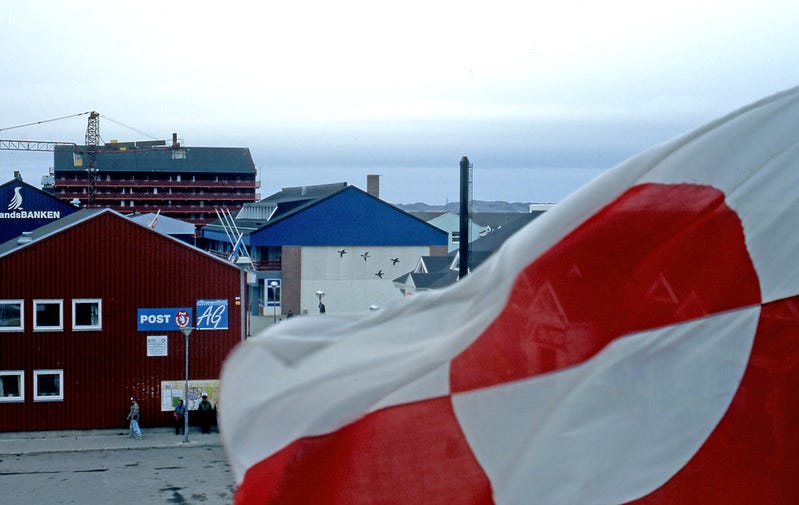
Photo: “The Greenland flag in the capital Nuk, Greenland” by GRID-Arendal, CC BY-NC-SA 2.0 via Flickr.
Note: RealityCheck does not take a position for or against America’s strategy toward Greenland. We do, however, believe that complete information is necessary for every individual to come to their own, fully informed conclusions.
This is our attempt to provide that critical background.
Greenland is not a country.
Contrary to popular mythology, Greenland is not a country: it is a semi-autonomous territory under the rule of the Kingdom of Denmark.
Almost entirely uninhabited, Greenland is over triple the size of Texas, but with a total population less than the current enrollment of Ohio State University. This is no accident: as recently as 1991, Denmark was still implementing a long term campaign of forced sterilization against the native Inuits, including against girls under 15 years old.
Denmark’s inhuman behavior shouldn’t be terribly surprising – aside from its notorious “Ghetto laws” and controversial asylum policies, the country is also viciously aggressive toward Israel: including hysterical accusations of war crimes, and rampant, unchecked local antisemitism.
Denmark helped lead a European effort to cut trade relations with Israel last year – a move which could have obliterated the Israeli economy, one third of which depends on EU trade. This bizarre attempt at economic warfare against a European ally did not succeed, in part due to our work here at RealityCheck: click HERE to learn more about the role we played.
What do the people of Greenland want?
Most Greenland residents say they want independence, but nearly half oppose independence if it were to mean a decrease in standards of living — which it would: the territory relies on Denmark for almost half of its annual budget. This calls into question the claim by Greenland’s Prime Minister that the island “cannot be bought.” It seems that Greenland not only can be bought, but already has been.
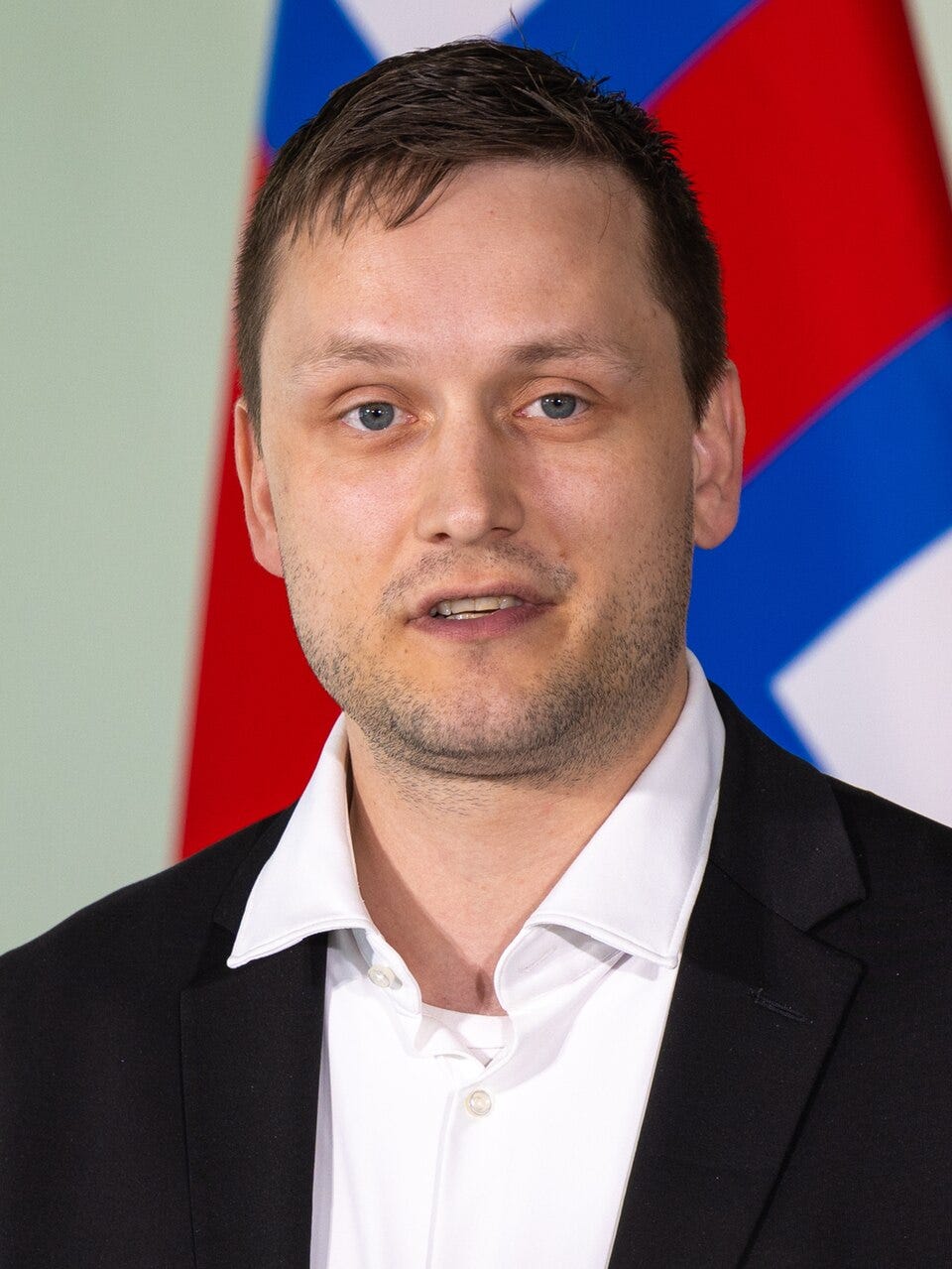
Photo: Greenland’s Prime Minister Jens-Frederik Nielsen via Wikimedia Commons.
European moralizing
Denmark holds Greenland in a state of economic captivity, which local residents do not want, but cannot escape. It is one thing to critique an American takeover of the territory, which Greenland’s residents widely oppose, but it is quite another to claim any kind of moral high ground in light of Denmark’s ownership position. Europe, as is so often the case, remains far from the “paragon of virtue” that it pretends to be.
Why does America want Greenland?
Whoever controls Greenland controls the safety of the United States, Europe and all of Western civilization. This is not obvious from looking at the standard “Mercator Projection” map of the world, but when viewed from a northern polar projection, the reason becomes clear:
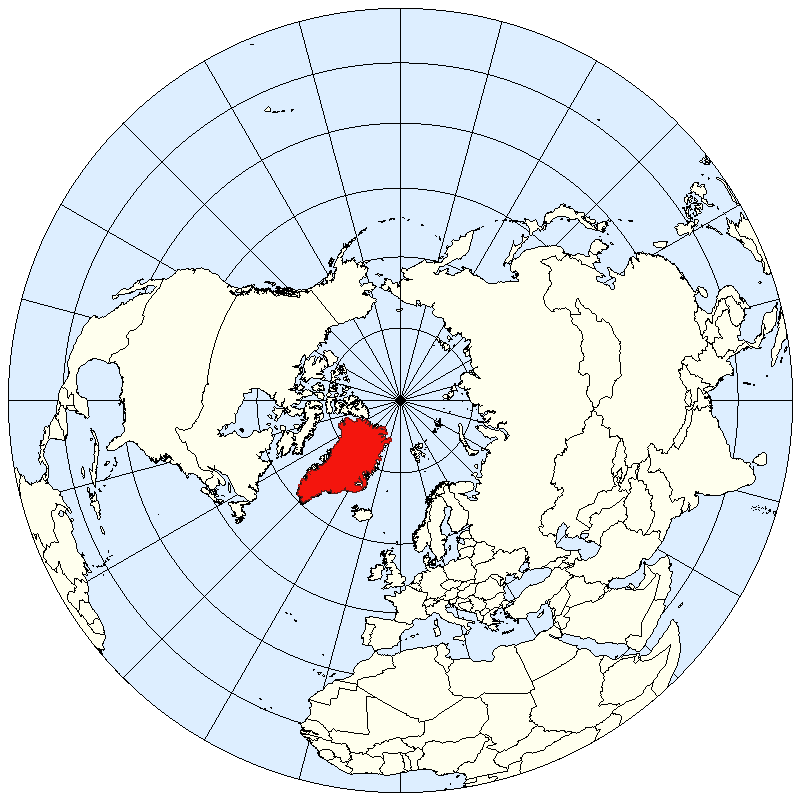
Photo: Northern Hemisphere via Wikimedia Commons, with modifications by RealityCheck.
Greenland (shown in Red) sits midway between the United States and Russia, and almost midway to China: the two most critical U.S. adversaries in the world today.
Indeed, U.S. bases in Greenland played a critical role protecting the United States from physical invasion in both the Cold War and World War II. If China or Russia were to take control of Greenland today, they would achieve a significant military advantage, enabling devastating kinetic attacks against the U.S. mainland.
Greenland’s positioning has become even more critical in recent years, as melting polar ice is opening up an increasingly navigable “Northwest Passage” through the Arctic, with significant economic and military implications.
No, Europe is not going to war with the United States
Various NATO allies sent symbolic numbers of troops to Greenland in recent days, framing the move as “saving” Greenland from the United States. Yet it’s worth paying careful attention to President Trump’s reaction: he has actually criticized Europe for not sending enough troops.
For example, Trump told reporters last week, “I can’t rely on Denmark being able to fend [Russia and China] off…they put an extra dog sled there last month, they added a second dog sled. That’s not going to do the trick.”
In fact, Denmark has sent about 100 troops in recent weeks, and other countries, such as France and Germany have sent about a dozen each, all merely symbolic numbers. Yet even if Denmark were to send its entire military, it would pale in comparison to the militaries of Russia and China, each of which are over thirty times larger than Denmark’s.
Do Russia and China actually have designs on Greenland?
Critics rejec that China or Russia pose a threat toward Greenland. Similarly, Russia and China both deny any military or otherwise aggressive intentions. Some frame the entire matter as an American pretext to take over Greenland’s natural resources, which include “rare earths” — a type of mineral critical for certain technologies.
On the other hand, this framing is almost exactly the way Europe downplayed Hitler’s ambitions prior to the Munich conference in 1938, a mistake that led to the most destructive war in human history.
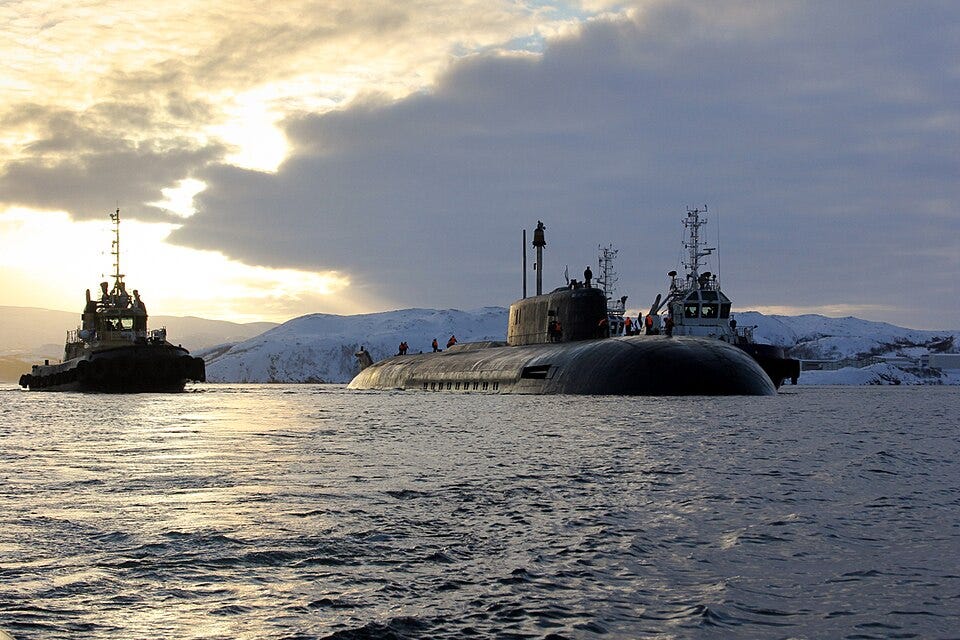
Photo: Russian nuclear submarine in the Arctic, via Wikimedia Commons.
In contrast to claims of innocence, China has implemented an unprecedented surge of civilian and military ships in the region, including joint Arctic military patrols with Russia. On the economic front, China announced an “Arctic Policy,” which some analysts characterize as an effort to create de facto control in Greenland and other Arctic areas.
For its part, Russia has re-opened dozens of Soviet era bases in the region and significantly increased its war games activities, in addition to the aforementioned joint military patrols with China.
Numerous analysts see these moves as a precursor to eventual military action and the analysts have an unexpected ally: Denmark’s own Joint Arctic Command in Greenland warns that Europe’s current focus on the United States is a “distraction” from the threat posed by Russian naval activities. This Danish on-the-ground military assessment contradicts Denmark’s own political echelon, as well the much EU’s political elite.
What to conclude?
Again, it is not our intention to insist on a conclusion one way or the other regarding the disposition of Greenland. Yet narratives of European morality, American aggression, and Russian/Chinese innocence, are (in the words of Denmark’s own Joint Arctic Command) “distractions.” Only by discarding these distractions can one begin to develop a properly informed opinion as to the true nature of events, and the best course of action moving forward.