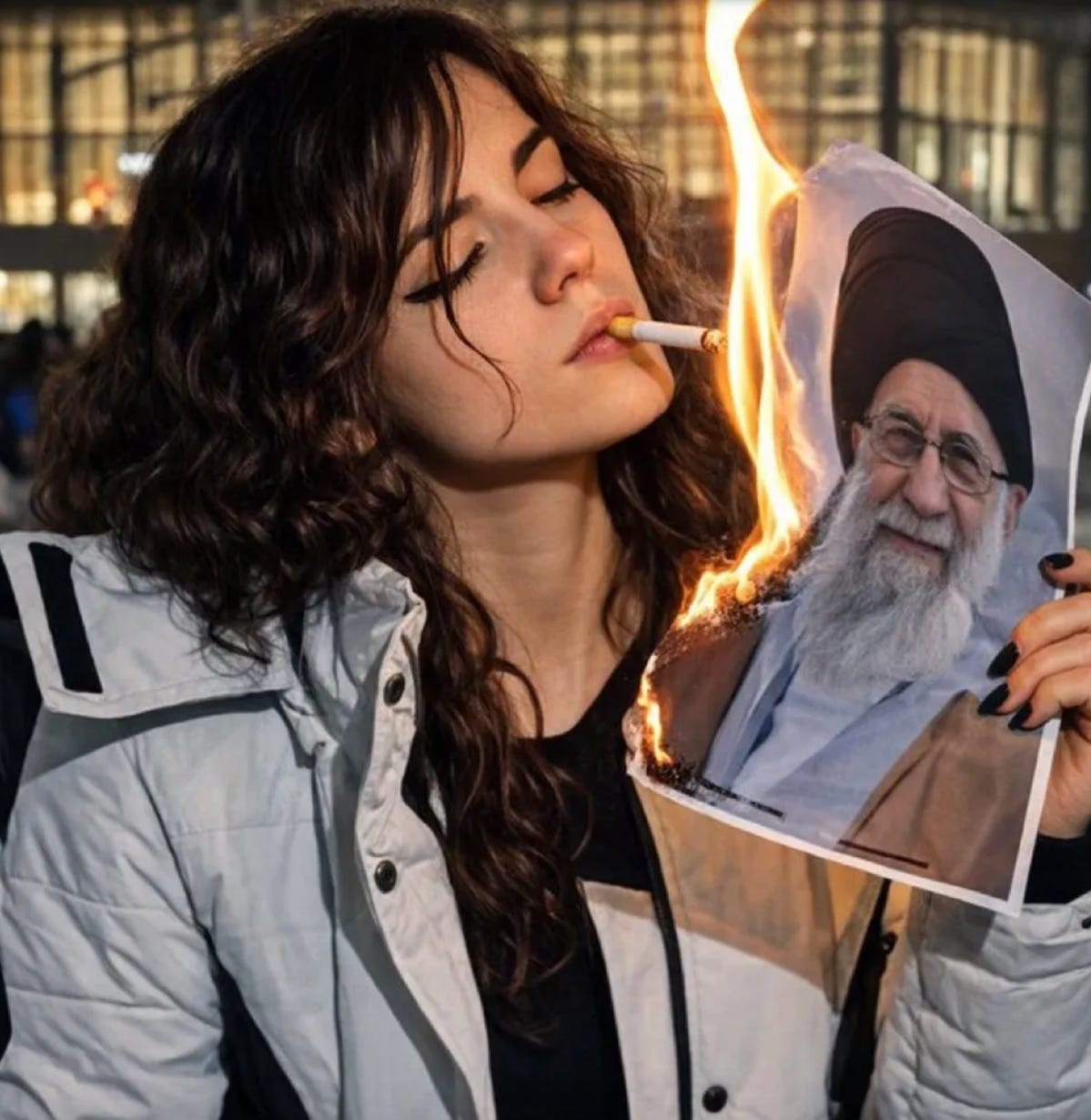
Photo: Iconic image of a woman lighting her cigarette using a burning photo of Iranian Supreme Leader Ayatollah Ali Khamenei.
*Note: One fact checking site proposed that the above image was not actually photographed inside Iran, though this criticism has not been confirmed. Regardless, the image has become an iconic symbol of the current protests, and has been imitated by numerous others who are confirmed to be within Iran.
What is actually happening?
Anti-regime protests erupted in Teheran on December 28, and quickly spread throughout the country, with protesters numbering in the millions.
The reasons relate not only to Iran’s economic collapse, but decades of brutal, often deadly repression and religious autocracy, in a country that used to be one of the most open and flourishing in the Middle East.
Iran has seen other protests over the years, but something is different this time.
The core slogan of the “Green” protest movement, after contested elections in 2009, was “Where’s my vote?” The 2022 “Hijab” protests were sparked by the death of Jina Mahsa Amini, who died from severe beatings while in custody, after her arrest for walking in public without a hijab, a traditional Islamic head covering. The common chant was “Women, life freedom.”
Yet the today’s protests include chants of “Death to the dictator” (Supreme Leader Khamenei) and “Long live the Shah,” (the prior monarchy, before the 1979 Islamic Revolution). Such framing is new in Iran, and an unambiguous call for regime change. Mohammad Reza Pahlavi, son of Iran’s last Shah and current “Crown Prince-in-exile,” has been actively encouraging the protesters from abroad, and has become a unifying symbol of the protests.
Yet first clue of something truly, dramatically different came on December 29, when a short but stunning tweet surfaced from the Mossad’s Farsi language X account:
We are with you. Not just from afar and verbally. We are with you in the field as well.
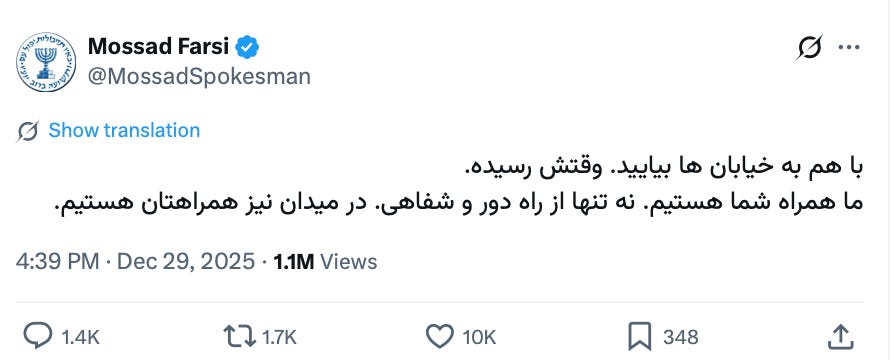
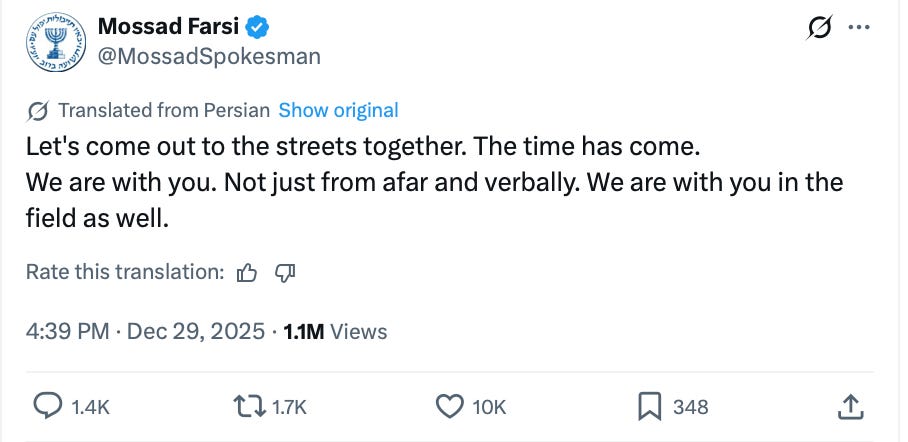
While Israel’s “Mossad” intelligence agency has never officially taken credit for the “MossadSpokesman” X account, relevant experts believe it is genuine.
The importance of this small, unassuming two line tweet cannot be overstated: for the first time since the 1979 Islamic Revolution, a major power had just promised on-the-ground support to the Iranian people.
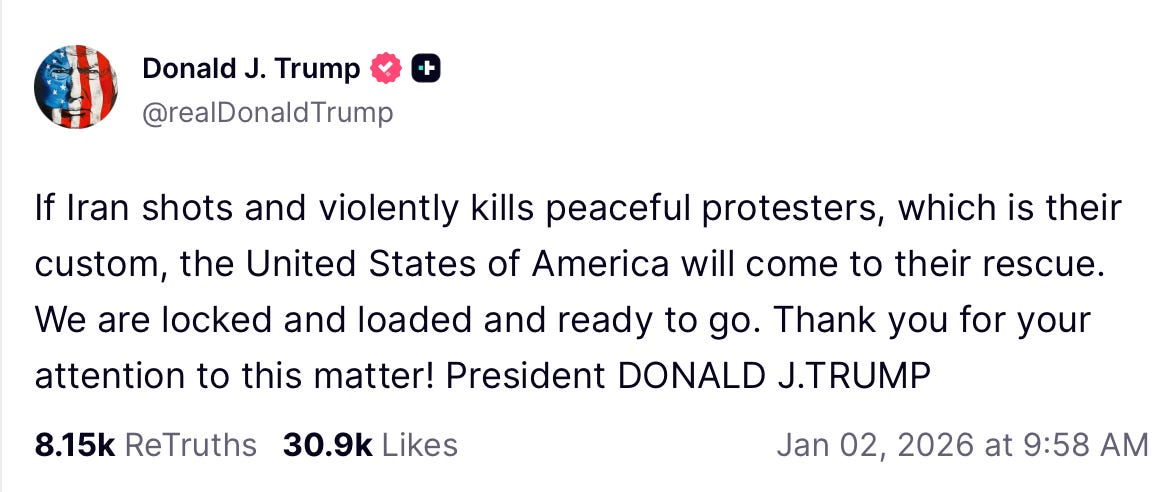
Four days later, on January 2, U.S. President Donald Trump warned the Iranian regime against shooting protesters, promising that America “will come to their rescue” and included the phrase “locked and loaded” – which seemed to imply potential military action as opposed to mere sanctions or diplomacy.
Less than 24 hours later, U.S. forces entered Venezuela and captured disputed president Nicolas Maduro – a display of America’s staggering military capabilities and, even more importantly, a newfound willingness to use them. Maduro was also a significant Iranian ally, among the the regime’s last after the fall of its entire Middle East proxy network.
Utterly astounding reports surfaced of protesters taking control of the cities of Abdanan and Malekshahi, though it is not clear to what extent protests exercised true physical control, nor whether that control actually lasted.
Beginning on January 8, the regime took several ominous steps:
-
Shuttering the internet and even much of the regular telephone network, including jamming Elon Musk’s satellite based Starlink system;
-
Activating the IRGC – an especially loyal and violent armed force that is designated as a terror organization by much of the world;
-
Launching a highly aggressive crackdown on protesters.
Information is limited and difficult to confirm without internet access (apparently by design), however reports of fatalities range from hundreds to thousands in just 48 hours, with over 10,000 arrested, and numbers growing by the hour.
Will the regime fall?
Renowned American sociologist and political scientist Jack Goldstone describes five factors that must be achieved for a successful revolution and regime collapse:
-
National Economic or Fiscal Strain: This is definitely the case in Iran, where the currency dropped by well over 99% since 1979 and basic necessities, such as food, water and electricity are in short supply.
-
Alienation and Opposition Among the Elites: As far as we know publicly this has not yet occurred, yet the regime has already begun to fear defections by the regular army. Such defections will be a significant turning point, if and when they occur.
-
Widespread Popular Anger at Injustice: This is clearly the case, as demonstrated by nearly every paragraph of this article.
-
A Persuasive Shared Narrative of Resistance: This is also the case, with widespread focus on ending the current regime, and on Crown Prince Pavlavi as a unifying figure.
-
Favorable International Relations: This is the key differentiator.
Any group of unarmed protesters, no matter how large or highly motivated, will be unlikely to prevail against a well armed and well trained fighting force without outside assistance.
Indeed, this was the case during the Green Protests in 2009, which (then) U.S. President Barak Obama, failed to support, admitting in 2022 that this was a mistake. Yet Obama’s administration did more than merely neglect the protesters: the United States effectively propped up the Iranian regime through billions in sanctions relief and other measures, even before the 2015 nuclear deal.
Yet times have changed.
Israel’s “Twelve Day War” last June decimated not only Iran’s nuclear program, but also the illusion that the Iranian regime was somehow invincible. The collapse of Iran’s entire Middle East proxy network, including Hezbollah in Iran, Hamas in Gaza, and the Assad regime in Syria, was followed by the collapse of yet another Iranian ally this month: Nicolas Maduro in Venezuela.
Since that time, the United States has been signaling a clear intention to support the protesters, with Trump reportedly considering military options at a briefing tomorrow (Tuesday).
Will U.S. involvement backfire?
It’s called “rally around the flag”: the idea that when faced with an outside threat, even fierce competitors will join forces out of a sense of shared nationalism. Republican Senator Rand Paul raised this critique yesterday, echoing President Obama’s faulty reasoning in 2009. Yet in this case, the theory is not supported by history: Iranians felt overwhelmingly betrayed by President Obama’s previous neglect, and are now pleading for President Trump to take strong action, including cries of “Help, we need HELP” and, “Trump, a symbol of peace. Don’t let them kill us.”
The Day After
It is relatively rare that an aggressive dictatorship transforms into a safe and prosperous neighbor, but there are at least two historical examples: Germany and Japan after World War II. In both cases, the previous regime had to be completely defeated and entirely disarmed, and the Allied powers occupied the respective countries for years, while building entirely new societies from scratch.
Such an investment seems unlikely in this case, so is Iran doomed to failure without similarly severe intervention?
Perhaps not, given that the Iranian people have a unifying vision of a liberal, secular democracy, a unifying figure in the form of Crown Prince Pavlavi, and a strong desire to become a free and prosperous member of the international community. Yet one thing is clear: if Iran’s Islamic regime falls, that will be only the first step in a sensitive, complex and extremely high stakes process: for Iran, its neighbors, and the world.